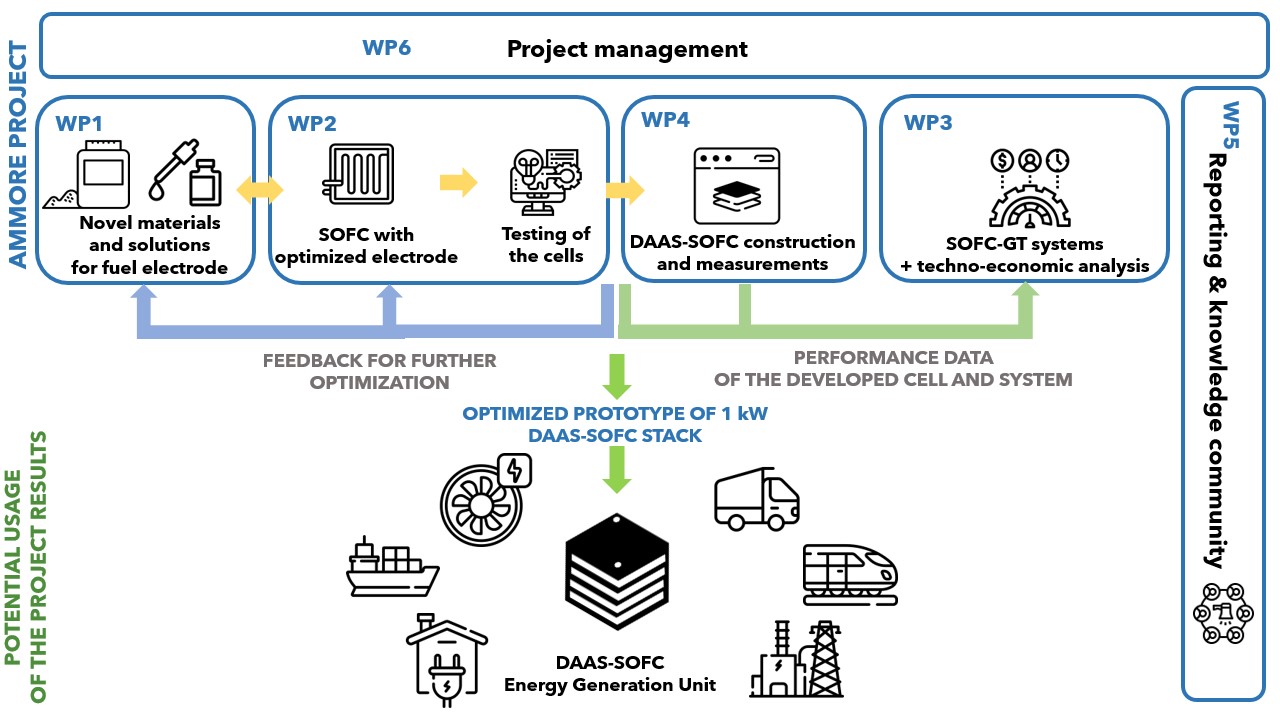


The overall objective of AMMORE project is to develop a standardized modular and multipurpose kW-class energy generation unit (EGU) based on an intermediate temperature solid oxide fuel cell (SOFC) stack powered by ammonia. A key goal is to position ammonia as a sustainable, efficient, and economically viable fuel for SOFC-based systems. The project will accomplish this by developing advanced materials, adapting cell fabrication techniques, optimizing stack conditions for ammonia compatibility, and designing durable systems for a variety of applications, including long-distance transportation, hybrid SOFC-gas turbine solutions, and distributed energy production. Through extensive testing, safety protocol development, and techno-economic analysis, AMMORE aims to demonstrate the feasibility and scalability of ammonia-powered SOFCs as low-emission alternatives to traditional carbon fuels. The primary aim of the project will be achieved through a step-by-step approach, targeting the following objectives:
- Tailoring the design of the state-of-the-art (SoA) anode-supported SOFC to use ammonia as sustainable fuel (DAAS-SOFC, which stands for Direct Ammonia Anode Supported SOFC).
- Designing and developing a customized fuel electrode with superior catalytic activity and enhanced durability for facilitating direct electrochemical NH3 oxidation, thereby enabling the removal of an external ammonia cracking reactor from the system.
- Investigating the durability of single cells fed by NH3 and defining the stable modus operandi for DAAS-SOFC to minimize degradation rates.
- Enhancing the existing IEN-PIB SOFC stack design for the usage of ammonia and demonstrating operability on short stacks (5-10 cells).
- Developing a modular and multipurpose EGU to convert ammonia to electricity and heat with outstanding high-efficiency. EGU will be based on a 1 kW class DAAS-SOFC stack.
- Studying the operability of the EGU, including long-duration tests (1,000+ hours) with NH3 and examining fuel flexibility (performance on H2 and H2-N2/NH3 mixtures) for alternative applications.
- Adjusting the design to safety protocols and fuel delivery solutions for ammonia in SOFC systems.
- Completing modeling and techno-economic variant studies on the EGU's applicability across various sectors, e.g. transportation and energy sectors, including analysis of the hybrid DAAS-SOFC-gas turbine systems as one of the options for industrial deployment.
The AMMORE project objectives are tailored to cover technical, environmental, and economic aspects of using ammonia as a clean fuel source. The project aligns closely with the CETPartnership Joint Call 2024 Call Module CM2024-05 Hydrogen & renewable fuels, focused on advancing hydrogen and renewable fuels, by developing a scalable, ammonia-fueled multipurpose EGU. The intended, measurable outcomes – a prototype EGU system with new materials solutions for SOFC stack, together with techno-economic analysis, will contribute to the development of efficient and environmentally friendly technical solutions, which are essential for achieving a climate-neutral economy. The Technology Readiness Level (TRL) is expected to rise from TRL4 at the start of the project to TRL6 by its completion. The project's objectives are ambitious yet achievable, thanks to a well-structured work plan, precise task division, and the cumulative expertise of the project consortium’s members, complemented by diverse skills and knowledge.